ABSTRACT
The present study aimed to compare the effect of education through problem-based learning (PBL) or lectures on behavior, attitude and learning of nursing students. A total of 40 second-year nursing students participated: 20 students in the PBL group and 20 students in the traditional lecture (control) group. The students underwent a one-semester course using the two methods of education. The level of knowledge in the PBL group was significantly higher than that of students in the lecture group. In addition, a significant difference was found between the PBL and lecture groups in the level of attitude toward learning. The present study suggests a significant difference between PBL and traditional lecture groups with a more positive learning attitude and higher learning motivation in the PBL group (NCT00747188).
Teaching is one of the learning processes with an efficient influence on educational organization. Many educators have long advocated the teaching of critical thinking skills such as reasoning and problem solving [1].
Nowadays, the improvements in medical technology and patient care have transformed nursing into a complex profession. An efficient nurse requires a significant level of skills in order to overcome practical difficulties [2]. Most universities in the world are trying to develop educational approaches by which practical decision-making and self-confidence are enhanced in students [3]. Nurses have found that there is a gap between theory and practice with many unable to carry out medical procedures [4]. Education with an active learning component may result in an improved nexus between the education and medical practice [5].
Students who undertake more traditional lecture-based teaching just memorize what they have been taught instead of concentrating on medical concepts and their use. Due to the learner's passive receipt of knowledge, such students show a passive approach to medical practice and use a low level of invention and recognition-based thinking to solve medical problems [6]. In nurse education, the relation between theory and services is strengthening. Nurse education may be significantly improved if new teaching practices are introduced.
One suggested way to bridge the gap between education and medical practice is to change the traditional education system (lecture-based learning) into a problem-based learning (PBL) approach which historically can be traced back to Socrates [7].
The passage below is adopted from the private teacher educational system at Oxford University, UK:
In the 1950's the university of the Unites States designed educational strategies which introduced patients' histories and laboratory works to medical students in the various fields and subjects [8]. The PBL was initially introduced at University of McMaster, Canada, in 1966, and aimed to increase students' abilities in independent study, problem-solving skills and analysis [9]. In 1971, PBL moved to Europe; the first faculty to use this strategy was the Mastrich Faculty of Limberg University. In 1982, medical teachers were introduced to an independent study as a basis of education and hence PBL was selected as an appropriate method to achieve the aim.
PBL introduces a problem as part of learning and can be used as a means of self-study [10] and a way of increasing critical thinking skills and attitudes in students [11]. Even though there may not be a solution, an environment will be produced in which the students will have to study and recognize the subjects and work through the problems [12]. Thus, if we assume that the inefficient performance of nurses in practice is due to a gap between education and practice, the replacement of the current method of training with one which is able to increase critical thinking skills should provide improved educational outcomes. Amongst all new educational methods the best strategy probably is PBL.
Most PBL studies on nursing students have been conducted in Europe and North America. There is no such research in Asian countries. In Iran for instance, most investigations have been undertaken by medical and basic sciences and rarely by nursing. Further, studies conducted in Iran in the field of nursing were mostly concerned with aspects of general recognition; they were not focused on the levels of understanding, application, analysis, combination and evaluation. In addition, they have not considered the influence of PBL and lecture methods on the behavior of students. Thus, PBL may result in an increase in learning, self- and continuous learning, concentration on concepts, invention and acquirement of social skills (needed by nurses in the medical environments). As education in nursing needs motivation to produce invention, the nursing profession should be expanded. The present study aimed to compare the effect of education through PBL or lectures on behavior, attitude and learning of BSc nursing students in the Medical Faculty of Shahrekord University, Iran.
ABSTRACT
The present study aimed to compare the effect of education through problem-based learning (PBL) or lectures on behavior, attitude and learning of nursing students. A total of 40 second-year nursing students participated: 20 students in the PBL group and 20 students in the traditional lecture (control) group. The students underwent a one-semester course using the two methods of education. The level of knowledge in the PBL group was significantly higher than that of students in the lecture group. In addition, a significant difference was found between the PBL and lecture groups in the level of attitude toward learning. The present study suggests a significant difference between PBL and traditional lecture groups with a more positive learning attitude and higher learning motivation in the PBL group (NCT00747188).
Teaching is one of the learning processes with an efficient influence on educational organization. Many educators have long advocated the teaching of critical thinking skills such as reasoning and problem solving [1].
Nowadays, the improvements in medical technology and patient care have transformed nursing into a complex profession. An efficient nurse requires a significant level of skills in order to overcome practical difficulties [2]. Most universities in the world are trying to develop educational approaches by which practical decision-making and self-confidence are enhanced in students [3]. Nurses have found that there is a gap between theory and practice with many unable to carry out medical procedures [4]. Education with an active learning component may result in an improved nexus between the education and medical practice [5].
Students who undertake more traditional lecture-based teaching just memorize what they have been taught instead of concentrating on medical concepts and their use. Due to the learner's passive receipt of knowledge, such students show a passive approach to medical practice and use a low level of invention and recognition-based thinking to solve medical problems [6]. In nurse education, the relation between theory and services is strengthening. Nurse education may be significantly improved if new teaching practices are introduced.
One suggested way to bridge the gap between education and medical practice is to change the traditional education system (lecture-based learning) into a problem-based learning (PBL) approach which historically can be traced back to Socrates [7].
The passage below is adopted from the private teacher educational system at Oxford University, UK:
In the 1950's the university of the Unites States designed educational strategies which introduced patients' histories and laboratory works to medical students in the various fields and subjects [8]. The PBL was initially introduced at University of McMaster, Canada, in 1966, and aimed to increase students' abilities in independent study, problem-solving skills and analysis [9]. In 1971, PBL moved to Europe; the first faculty to use this strategy was the Mastrich Faculty of Limberg University. In 1982, medical teachers were introduced to an independent study as a basis of education and hence PBL was selected as an appropriate method to achieve the aim.
PBL introduces a problem as part of learning and can be used as a means of self-study [10] and a way of increasing critical thinking skills and attitudes in students [11]. Even though there may not be a solution, an environment will be produced in which the students will have to study and recognize the subjects and work through the problems [12]. Thus, if we assume that the inefficient performance of nurses in practice is due to a gap between education and practice, the replacement of the current method of training with one which is able to increase critical thinking skills should provide improved educational outcomes. Amongst all new educational methods the best strategy probably is PBL.
Most PBL studies on nursing students have been conducted in Europe and North America. There is no such research in Asian countries. In Iran for instance, most investigations have been undertaken by medical and basic sciences and rarely by nursing. Further, studies conducted in Iran in the field of nursing were mostly concerned with aspects of general recognition; they were not focused on the levels of understanding, application, analysis, combination and evaluation. In addition, they have not considered the influence of PBL and lecture methods on the behavior of students. Thus, PBL may result in an increase in learning, self- and continuous learning, concentration on concepts, invention and acquirement of social skills (needed by nurses in the medical environments). As education in nursing needs motivation to produce invention, the nursing profession should be expanded. The present study aimed to compare the effect of education through PBL or lectures on behavior, attitude and learning of BSc nursing students in the Medical Faculty of Shahrekord University, Iran.
Material and Methods
The experimental design was a quasi-experimental with a control group (NCT00747188). Following Hwang & Kim [13], forty-five second-year nursing students in the Medical Faculty of Shahrekord University were asked to participate. All 45 students agreed to take part however, due to the incomplete responses, three students in the experimental group and two subjects in the control group were excluded. This resulted in a total of 40 subjects. They were randomly assigned to either the PBL or lecture groups: 20 in the PBL group and 20 in the lecture group. Therefore, the 40 students were equally distributed between the two groups, but otherwise randomly selected by taking every second participant from a randomly organised computer file [14]. While all students had previously experienced lecture delivery, none had any prior exposure to PBL. Students underwent a one-semester course (Internal Surgery). Hydroecelctrolyte, Kidney and Urinary Ducts courses were subjects taught using the two methods of education.
The traditional method of education, i.e. the lecture, was assigned as the control group and the PBL as the case group. In the latter, after selecting the problem by the supervisor and providing a scenario, learning requirements were indicated by the students. They then were referred to the sources of information with no limitations on their use.
In the next session, after introducing the problem to each student, different aspects of the problem were debated. A PBL tutor facilitated the discussion. Data were collected using three questionnaires consisting of the students' attitude (Pearson's 95%), a check list of educational behaviors and the student's learning. Following Hwang & Kim [13], knowledge was tested by an objective developed by the investigator. The test consisted of 45 questions that were selected from the Internal Surgery for Nursing Students: one point for each right answer and zero points for each wrong answer were considered. Thus the score ranged from zero to 45 points. Learning attitudes were measured by a 16-item questionnaire, each with a 5-point Likert scale. Therefore scores ranged from 16 to 80 points, higher scores showing better attitudes toward learning. The reliability had a Cronbach's alpha of 85%. Data were analyzed using SPSS and the level of significance was set at p < 0.05 for all tests. Mann-Whitney test was used to compare the measurements of characteristics and dependent variables between the two groups.
Of the investigated groups (control and case) 95% were female and single. Age of the students ranged from 21 to 25 years with an average of 22.4 years (median = 23, range = 4). Grade point average or GPA (out of 20.00) of the students in the PBL group ranged from 12.40 to 17.50 with an average of 14.75 ± 1.35 and that in the lecture group from 12.28 to 19.48 with an average of 15.24 ± 1.64. The percentages of students who were partially satisfied, fully satisfied and unsatisfied from nursing educational programs were 45%, 30% and 25%, respectively.
Results
No statistically significant was found between the two groups in terms of grade, age, sex and marital status (p > 0.05). Table 1 compares research variables between the students of lecture-based and problem-based methods in terms of knowledge, understanding, concept, application, analysis, combination and evaluation using a Mann-Whitney test.
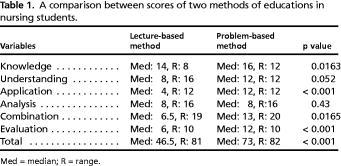
The level of knowledge in the PBL group was significantly higher than that of students in the lecture group. Also, the average scores obtained by the students in the PBL group were higher than those in the lecture group.
There is a significant difference between both groups in the application and evaluation categories (p < 0.05) but not in the understanding (p = 0.052). This suggests that the teaching method (be it PBL or lecture) has little bearing on the learning. In general, though no significant differences were found in the knowledge, combination, and analysis, the total scores in both methods of educations differed significantly.
The results show that the attitude and behavior of students in relation to two methods of learning differed. A statistically significant difference was found between the PBL and lecture groups in the level of attitude toward learning. Table 2 shows the scores of evaluation of attitude and behavior of students in relation to the learning using the lecture and PBL methods. As shown, students in the PBL group had significantly higher attitude scores (median = 130, range = 77) compared to the control group i.e. lecture (median = 96, range = 29; in both p < 0.05). The same occurred for the behavior between the two groups (in the PBL median = 69.5, range = 10 and in the lecture median = 63, range = 13; in both p < 0.05).
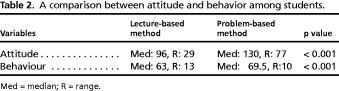
In general, the scores of attitude and behavior in the case students (PBL) were higher than to the control students (traditional-learning method).
Discussion
PBL was developed in the mid-sixties as a useful instructional alternative to conventional (lecturing) teaching [15]. It is designed to help students construct an extensive and flexible knowledge base, develop self-directed learning skills, and become intrinsically motivated to learn [16]. The PBL in fact, establishes a format through which students learn [17]. Given largely equivocal, PBL has some positive priority to traditional methods [18-21]. For example, while no differences in learning styles between groups of students in a traditional versus a PBL curriculum was found in a recent study by McParland et al [22], the PBL group, however, obtained better examination performances. In fact, students claim that PBL provides a more satisfying learning experience than traditional methods [23].
In recent decades, PBL has been proposed as an alternative to learning by the traditional lecture method [24]. Increasing retention, interest, and motivation are some benefits of PBL [25]. Learning by the PBL method also improved clinical reasoning skills, clinical knowledge, learning motivation, and learning autonomy [25]. As performance of nursing requires a cognitive ability that includes problem solving, decision making, and clinical judging, it is important for nurse educators to find appropriate teaching methods to enhance students' performance of these tasks for clinical nursing [26]. In addition, PBL is more student-centered and focuses on comprehensive learning of nursing concepts without regard to specialties of nursing courses [27].
This study found that the knowledge scores of students in the PBL group were significantly higher than those in the lecture group. The results of this study are consistent with those of previous studies, e.g. [28, 29], that reported improved learning and self-confidence among PBL students compared to lecture students. The PBL students had significantly higher overall scores on the completion of the semester compared with the lecture students. Similarly Koleini et al [30] showed that there was a significant difference between the traditional-based learning and PBL in that the PBL may lead to better learning than to the lecture method.
The results of this study, however, are in contrast to other studies, reporting that nursing students in the PBL group had significantly lower knowledge acquisition compared with those who received the lecture method [31-33].
This study found a significant difference between PBL and traditional lecture groups so that a positive learning attitude was observed in the PBL group. This finding is in parallel with the previous study findings that PBL students had significantly higher scores in the learning attitude than those of traditional lecture students [34, 35].
The present study indicates that PBL is more efficient than lectures. Particularly there is a significant difference between the evaluation, application and understanding with learning. It can be inferred that also the PBL may lead to better learning in the recognition, especially in the evaluation, application and understanding, and this facilitates learning, an increase in self-learning skills, lifelong learning and social skills. In addition, it causes an increase in the power of matters analysis, learning skills, connecting with each other, and an increase in the level of knowledge in the nursing students [1, 6]. Nevertheless, the results of Javid's study [36] showed that the lecture method rather than PBL had had influence on the learning. The difference in the results could be due to the different investigated communities, methodology, number of individuals, and method of education.
It has been shown that student' attitudes are factors which significantly influence student performance in PBL courses [37]. Two qualitative studies by Ishida and Rideout (both as cited in 25) showed that students in the PBL group had more positive and comprehensive attitudes than the lecture group. Likewise, in this study the scores from evaluations of attitude and behavior of students compared to the traditional and PBL methods showed that the scores of the latter were higher than the former. Similarly, the results of other studies showed that PBL caused the level of attitude and behavior of students to be enhanced [6, 38]. In Azar's study [7] the active learning methods, e.g. PBL, led to an increase in the behavior of students. Also, the Kentucky's internal students had fair thought in relation to the new educations of the medical personnel [38]. Or future research whether feasible for PBL to be used in nursing.
References
- Heravi M, Milani M, Rogeh N. The effects of educations through lecture and group investigation on level of learning nursing students. Iran Mag Edu Med Sci 2004;11:55-60.
- Salsali M. The development of nursing education in Iran. Internat His Nurs J 2000;5:58-63.
- Magnusen L, Ishida D, Itano J. The Impact of the use of inquiry based learning as a teaching methodology on the development of critical thinking. J Nurs Edu 2000;8:160-17.
- Benoit B. Problem-based learning. J Nurs Edu 2003;19:331-9.
- Creedy D, Horsfall J, Hand B, eds. Problem-based learning in nursing education: an Australian view. Sydney: Benedigo Company, 1999.
- Bahmanpoor K, ed. The effects of problem-based learning on the development of students' critical thinking, attitudes and behaviour of nursing students. Tehran: Nursing Faculty of Medical University, 2002.
- Azar S. Problem-based Learning: a critical review of its educational objectives and rationale for its use. Saud Med J 2001;4:212-8.
- Glen S, Wilkie K, eds. Problem-based learning in nursing: a new model for new context. Boston: MAC, 2000.
- Gokhale AA. Collaborative learning enhances critical thinking. J Tech Edu 2003;7:219-29.
- Chenoweth L. Facilitating the Process of critical thinking for nursing. J Nurs Edu 1999;18:420-38.
- Bowers B, McCarthy D. Developing Analytical thinking skills in early undergraduate. J Nurs Edu 1993;32:620-6.
- Harderb O, Gibson O, eds. Teaching strategies: a guide to better instruction. USA: Houghton Mifflin Company, 1998.
- Hwang SY, Kim MJ. A comparison of problem-based learning and lecture-based learning in an adult health nursing course. Nurse Educa Today 2006;26:315-21.
- Avlund K, Mehlsen MY, Thomsen DK, Viidik A, Zachariae R. Physical functioning and use of health services in a young and old sample. Dan Med Bull 2008;55:147-51
- Loynes SMM, Rikers RMJP, Schmidt HG. Students' conception of constructivist learning: a comparison between a traditional and a problem-based learning curriculum. Adv Health Sci Edu 2006;11:365-79.
- Hmelo-Silver CE. Problem-based learning: what and how do students learn? Edu Psychol Rev 2004;16:235-66.
- Bahar-Özvar , Çuhadarolu F, Turan S. Cooperative learning: a new application of problem-based learning in mental health training. Med Teach 2006; 28:553-7.
- 18. Norman GR, Schmidt HG. The psychological basis of problem-based learning: a review of the evidence. Aca Med 1992;67:557-65.
- Albanese MA, Mitchell S. Problem-based learning: a review of literature on its outcomes and implementation issues. Aca Med 1993;68:52-81.
- Vernon DTA, Blake RL. Does problem based learning work? A meta-analysis of evaluative research. Aca Med 1993;68:550-63.
- Colliver JA. Effectiveness problem-based learning curriculum: research and theory. Aca Med 2003;31:299-301.
- McParland M, Noble LM, Livingston G. The effectiveness of problem-based learning compared to traditional teaching in undergraduate psychiatry. Med Edu 2004;38:859-67.
- Sanson-Fisher RW, Lynagh MC. Problem-based learning: a dissemination success story? Med J Austral 2005;183:258-60.
- Hwang SY, Jang KS. Development and implementation of problem-based learning packages on the respiratory and cardiac system. J Kor Ad Health Nurs 2004; 16:220-8.
- Finucane PM, Johnson SM, Prideaux DJ. Problem-based learning: its rationale and efficacy. Med J Austral 1998;168:445-8.
- Thomas RE. Problem-based learning: measurable outcomes. Med Edu 1997;31:320-9.
- Little P, ed. PBL in nursing. Newcastle, Australia: PBL Workshop Booklet, 2000.
- Gibson DR, Campbell RM. The role of cooperative learning in the training of junior hospital doctor. Med Teach 2000;3:297-300.
- Yang ND. Exploring a new role for teachers: Promoting learner autonomy. System 1998;26:127-35.
- Koleinie N, Shams B, Salehi M. Learning using lecture and PBL. Iran Mag Edu Med Sci 2002;10:57-63.
- Andrews M, Jones PR. Problem-based learning in an undergraduate nursing programmed: a case study. J Adv Nurs 1996;23:353-65.
- Frost M. An analysis of the scope and value of problem-based learning in the education of health care professionals. J Adv Nurs 1996;24:1047-53.
- Kim SA, Kang IA, Kim S. Development of a problem-based learning program in nursing education curriculum. J Kor Psychi Nurs 2000;9:559-70.
- Arthur D. The effects of the problem-based alcohol early intervention education package on the knowledge and attitudes of students of nursing. J Nurs Edu 2001;40:63-72.
- Hwang SY, Jang KS. Development and implementation of problem-based learning packages on the respiratory and cardiac system. J Kor Adu Health Nurs 2004;16:220-8.
- Javid MA. Comparison between the effects of lecturing and problem-based learning (PBL) on nursing students. Iran Mag Edu Med Sci 1998;50:35-42.
- Luh SP, Yu MN, Lin YR. A study on the personal traits and knowledge base of Taiwanese medical students following problem-based learning instructions. Anna Aca Med Sing 2007;36:743-50.
- Brynhildsen J, Dalhe LO, Behrbohm FM. Attitudes among students and teachers on vertical integration between clinical medicine and basic science within a problem-based undergraduate medical curriculum. Med Teach 2002;24:286-88.
A randomised controlled trial